
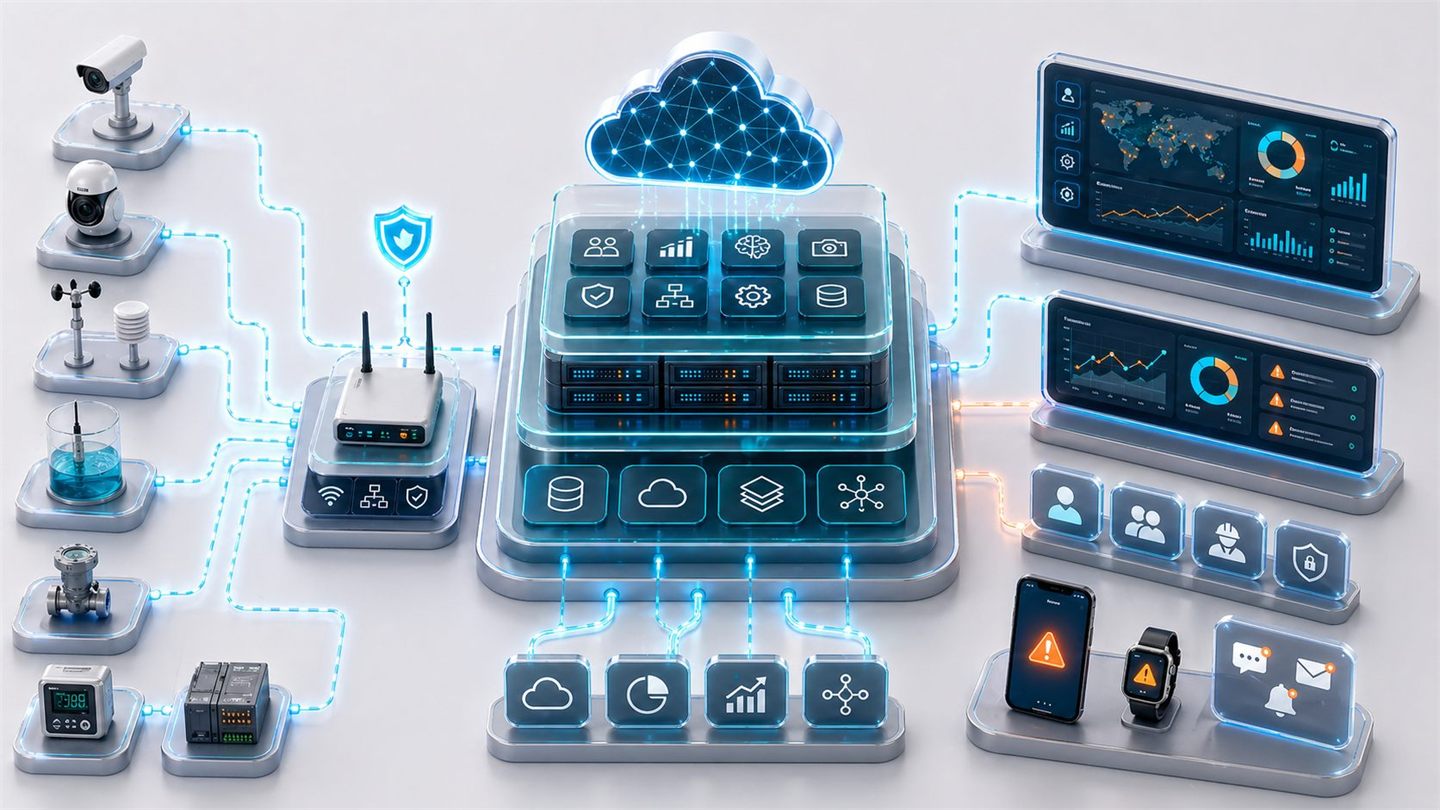
Distributed architecture with gateways, field devices, cameras, and external platforms connected to a unified operational history in Horus.
Architecture for a heterogeneous world
Horus is designed to operate with field devices that are very different from each other. Some publish data directly through IP, others require gateways, others only send SMS or LoRa packets, and others belong to external platforms that must be queried periodically.
1. Field
- Sensors, controllers, cameras, and logical devices record real-world states.
- Equipment may connect through IP, industrial buses, radio, cellular networks, or local links.
- Each site keeps its own characteristics without requiring a single brand or protocol.
2. Gateway
- Translates local protocols such as RS485, 1Wire, or 4-20 mA into a model compatible with Horus.
- Concentrates data from equipment that cannot connect directly to the cloud.
- Supports deployments in technical sites, industrial facilities, or remote locations.
3. Horus Cloud and operation
- Receives, normalizes, and stores information in its own history.
- Manages users, permissions, data availability, and operational rules.
- Integrates external sources and processes cameras as visual sensors.
- Feeds dashboards, alerts, predictive analysis, and forensic reviews.
- Coordinates that information with the rest of the platform: video, community, AI, automation, and mobile experience.
4. Ecosystem evolution
Horus's roadmap aims to expand the universe of integrated devices, add brands and ecosystems such as Tasmota, Sonoff, and Tuya, and strengthen the ability to turn any field source into usable information inside the platform.
5. Commercial scalability
The architecture can grow gradually: by site, zone, sensor family, asset type, or operational criticality. A deployment can begin with basic monitoring and evolve toward rules, automations, historical analysis, coordinated response, and new devices without changing the platform model.
This turns the IoT layer into a commercial base for operational continuity, preventive maintenance, remote monitoring, infrastructure control, and response automation services.