
Sensors, long-range communications, and operational history to anticipate flood events.
Operational challenge
Floods require early information from remote points, often with limited connectivity and complex geographic conditions.
Horus response
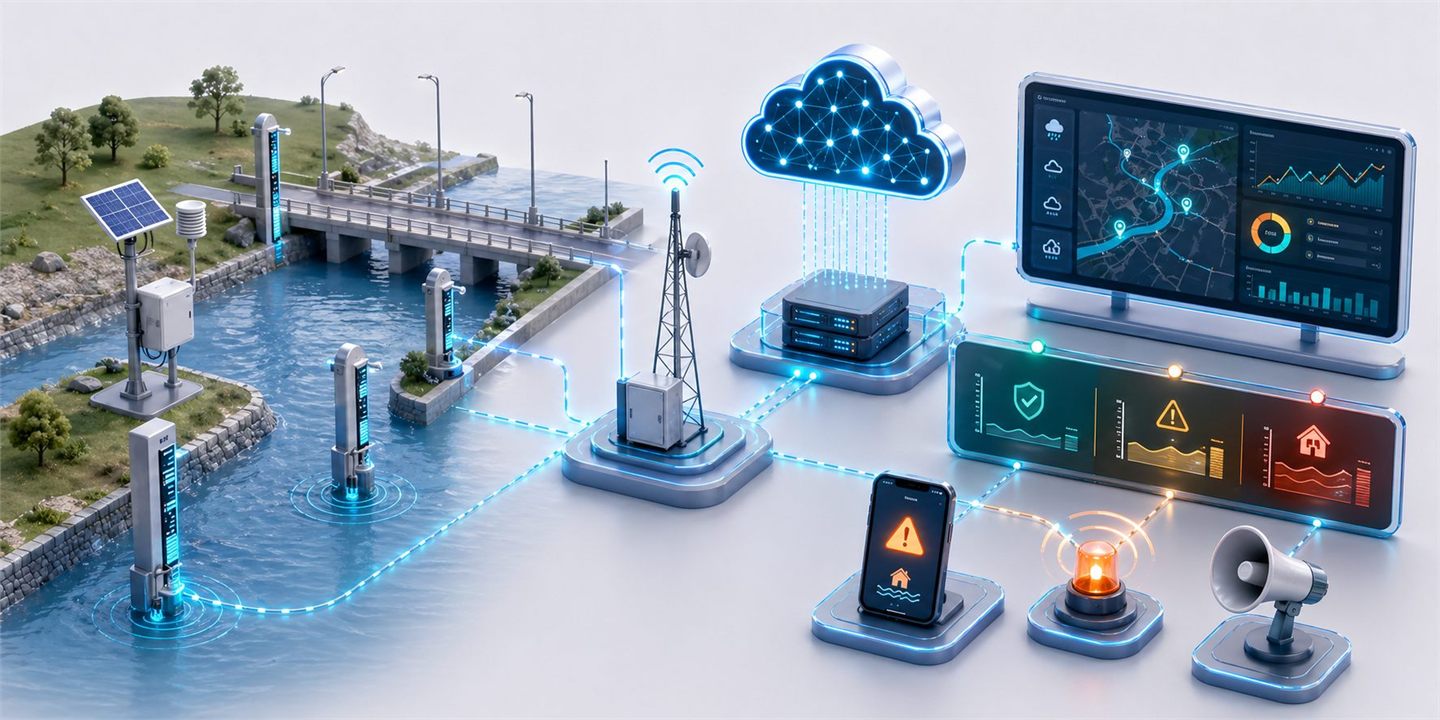
Horus integrates level sensors, gateways, LoRa, SMS, or IP communications, and its own history to track risk evolution and activate alerts.
How it works
Devices send periodic measurements. The platform normalizes data, compares it against thresholds and history, and enables alerts for authorized users.
Deployment model
Autonomous field sensors connected through LoRa, SMS, IP, or local gateways to Horus Cloud.
Key benefits
- Early detection of level changes
- Historical tracking of hydrological events
- Operation in areas with low connectivity
- Information shared according to roles and responsibilities
Typical applications
Overview
Early flood warning shows how Horus connects the physical world with decision-making. Sensors deployed at critical points feed a history that makes it possible to see trends, compare events, and anticipate risk conditions.
Included capabilities
- Level and environmental sensors
- Low-power, long-range communications
- Thresholds, events, and operational alerts
- Historical records for post-event analysis
Operational fit
This is a natural fit for operations that need continuous monitoring in places where stable connectivity and conventional power infrastructure are not always available.